Showing posts with label War On Wall Street. Show all posts

Saturday, July 9, 2011

Discussing Peter Thomas Senese's THE DEN OF THE ASSASSIN

1. 'The Den Of The Assassin' is a real-world story of the geopolitical realities society faces today. You accurately cover with reader-friendly acumen very complex topics including the global financial
markets, global political and military instabilities, modern-day biological, chemical, and cyber-warfare, and issues evolving around global-citizenship and communication. How much research was dedicated into creating 'The Den Of The Assassin'?


Writing primarily in historical fiction requires a writer such as myself the need to pay great attention to the presentation of substantial fact in the context of the story being crafted. 'The Den of the Assassin', similar to each of my historical fiction novels, is steep in heavy research. I spend a great deal of time studying various subject matter to the point that I become confident I can take a heavily complex issue and present it in a highly technical, easy to understand, and entertaining manner without losing the complexity of the issues being presented.

Conducting the type of research required for one of my novels takes time, particularly since the multiple issues I address and write about are complex and sometimes the necessary information I am seeking is not so easily accessible.

Combining the fact that my stories always have multiple intriguing plot-lines weaving throughout the fiber of the characters' movements and that my reader-audience typically is highly educated, sophisticated, and quite knowledgeable it is critical that I present accurate, current, and meaningful information - foundations, if you will - in order to create the necessary platforms for my characters' to stand on. In 'The Den of the Assassin', I spent a substantial amount of time researching the complex and fascinating issues that are presented; however, I was also able to draw upon my own deep knowledge base and understanding.


2. Wall Street appears to be a central theme for many of your writings. Why is this?
I view Wall Street as the cradle of America, and one of the most fascinating places in the entire world. Many individuals do not realize just how important a role Wall Street had during the birth of our nation. For example, Federal Hall, which is directly across from the still-mighty New York Stock Exchange, was our great nation's first capitol and the location were General George Washington was inaugurated as America's first president. It is the location where the United States 'Bill of Rights' was first presented to Congress - and a place of many fascinating national and local political secrets! And of course, it is, and should remain the symbolic center of capitalism.

Whenever I put my foot on the 'Street', I feel the raw energy and determination that was instilled from our nation's Founding Fathers. Today, I see this attitude in many individuals who work in the financial markets, and equally viewed, that very same determination that makes a New Yorker a New Yorker. With its deep national and local New York history, Wall Street is in itself a living, breathing character that is hard to replicate anywhere, so it is only natural for me to include in my writing a place that is so unique, historic, current, and personally attached to me.


3. In 'The Den Of The Assassin' America and the free-world face very real and possibly cataclysmic possibilities at the hands of individuals hell-bent on destroying our way of life. How real are the threats of a biological, chemical, or cyber-attack on our nation's soil?

Very real. Modern warfare has changed dramatically with each passing year. And as scientists continue to place great energy and resources into the science of genetic engineering, our reality is that the capacity for a biological attack has made giant strides toward becoming a serious reality. Chemical warfare, and all of its evil possibilities will also continue to increase. However, what appears to be most concerning is the rapidly expanding threats of cyber-warfare. Countries such as China, North Korea, and Russia have extensive, well-trained cyber-warfare military divisions working endlessly to create and develop deployment systems capable of delivering malicious software code and viruses capable of attacking and shutting down a computer network system. Juxtaposing the concern associated with the ever-expanding ability of each of these and other nations' abilities to engage in a new type of potentially crippling warfare - cyber-warfare - and attack our nation's electronic infrastructure is the fact that as a nation, the United States has become reliant on foreign citizens living abroad to fulfill a variety of computer-design and software needs. So in reality we have, in a certain sense, given away the keys to our nation's central nervous system.

For example, one of the more commonly accepted cyber-warfare strategies involves the use of 'Botnets'. Botnets or 'Bot Networks' are made up of vast numbers of compromised computers that have been infected with malicious code, and can be remotely-controlled through commands sent via the Internet. Hundreds or thousands of these infected computers can operate in concert to distribute spam, viruses, or other malicious code. Because Botnet attacks are decentralized and do not typically have a cyber-warfare command center it is near impossible to defend against, while also having the capacity to easily go viral - and spread from one computer network to another at any given time. Imagine if a Botnet is initiated on a worldwide social network such as Facebook.

With hundreds of millions of users capable of downloading a malicious virus capable of shutting down or destroying for example our electric power grid or our telecommunication lines or our banking system, which is not unrealistic, any nation facing this type of threat would have extraordinary challenges on their hands.


4. What risks are associated with our nation's reliance upon foreign countries and their citizens to design and build many of the computer operating systems and software that we use today?

The risks are very straight-forward: we have given the keys to our nation's nervous system - our electronic arteries - without carefully vetting who in fact we have given the keys to. For example, how do we really know who a company located in Eastern Europe that is designing an online video game for a U.S. based company has actually hired to complete software that will be utilized in the United States? We don't. Nor do we know if and what dormant malicious viruses they have installed. This is a very serious problem, and one that will manifest itself as individuals become more connected via the Internet.


5. Russia?

An extraordinarily dangerous country no matter what title Putin gives himself within the pseudo-democracy he controls. Combining the former KGB officers monger-like mentality with the facts that prior to 1991 the Soviet's Bioprepreat had an anticipated 200,000 scientist working in their illegal biological and chemical warfare division - a unit that surely has not disappeared in the wake of genetic advancement, Russia's extraordinary oil reserves, and similar to China, a great desire to remove the U.S. currency as the world's primary currency ... Russia has as it has in the past, its own agenda, and that agenda typically does not line up with the intended policies of the United States.


6. The Arab Spring?

It was one of the most spectacular uprisings by an oppressed people at any given time in history. Clearly, the remarkable use of the Internet to educate, communicate, and mobilize others in the name of freedom and liberty accomplished what outside governments spent incredible resources unsuccessfully doing: planting sustainable seeds of democracy. I think we're only seeing the beginning of true reform in the Middle East and I anticipate that democracy and freedom's light will shine through the oppressive darkness created by dictators.


7. North Korea?
 
North Korea remains a serious problem in part due to its close relationship to China, a psychopathic ruler who has propped himself to be viewed as a God by the country's citizens, substantial warfare capability coupled with its close proximity to South Korea. In its delicate balance, the world's leading countries continue to be in a quagmire on how to deal with North Korea. Though China has come out on occasion condemning North Korea's actions or policies, in my view, Beijing's still very deeply connected to North Korea and the rest of the world knows it. Economic sanctions utilized to protest that country’s various policies have not truly worked because at the end of the day, the troll has such complete power over the nation's citizens that those who suffer most are the nation's neediest citizens.

And this gives the troll even more power because he is able to point to the west and say to his loyal followers that their nation's difficulties are due to the policies of foreign governments intent to take over North Korea.

Which has lead to that country developing a very dangerous arsenal of tactical weapon capabilities - including the creation of a cyber-warfare division that has been in existence for nearly 25 years - when they created the 'Kim II Political Military University', which is also known as the 'secret college' that enrolls over 100 world-class computer hackers, who after graduation, are assigned to the 'General Bureau of Reconnaissance of the Ministry of the People's Armed Forces'.

And with South Korea its neighbor, any type of military conflict with North Korea will cause massive loss of life - so in a certain sense, and due to China's protective eye, the world can do very little other than hope that perhaps we see something similar to the Arab Spring.


8. China?

China is deeply connected to the world economy, which is a safeguard against modern warfare. However, in my opinion two of China's primary political and economic agendas to which they appear to be hell-bent on achieving include removing the U.S. dollar as the world currency standard, and, they're continued investment and creation of infrastructure into Africa. Their activity in Africa, though extremely helpful for many African nations, appears to be taking place in order to mobilize the nation-states of Africa for China's own purposes. Previously, these nations initially became highly instable after the Cold War presumably ended. Combining these goals with China's extreme military build-up - for example their creation of anti-aircraft carrier missiles possibly capable of taking out a nuclear-powered aircraft is in fact changing the way the United States military and in particular our navy prepares for future combat. And China has formed the ‘Blue Army': a very unique team of cyber-warfare computer experts that makes the North Korean's 'Kim II Political Military University' look like a Montessori school for young children. We're talking about a very serious threat, though the size and capability of the Blue Army is not fully understood. What we do know is that they do exist and that they have tremendous resources at their disposal so they may implement their project goals and expand their capabilities.


9. In 'The Den Of The Assassin', the story's protagonist is a Wall Street banker who unexpectedly gets caught in the cross-hairs of a psychopathic former Soviet Union war monger's sight and evil intent to cause grave destruction against America and the free world. Why did you choose to use a banker as the story's protagonist?
 There are many reasons why Tyler Boxter's profession is that of an investment banker. First, the complex story that is 'The Den Of The Assassin' has a very realistic and fungible set of scenarios that require the insight and expertise of a Wall Street insider. And as much as this story takes place on capitalism's Wall Street, the little-often spoken political side of Wall Street was a critical symbol that underscored the antagonist's intent: to destroy all things American and our way of living, including our grasp on liberty and capitalism. And in my mind, Wall Street was America's cradle for both our democratic and capitalistic way of life. So inevitably the story's protagonist needed to be a part of the street - and so Tyler Boxter - the most unsuspecting of individuals soon realizes that the Wall Street he knows is 'The Den Of The Assassin'.


10. How vulnerable are our financial markets to a cyber-attack and how would other nations, including Russia or China benefit if our national grid and computer infrastructure were compromised?

I think any country which had a partial or complete shutdown due to an unspoken declaration of cyber-war would have serious and long-ranging difficulties. Our nation's various national defense agencies spend enormous resources and place mind-boggling effort into ensuring that we detect and isolate cyber-attacks before they spread and cause great damage to our way of living. These individuals are truly our nation's unseen, unspoken, and undetected heroes. And their important role in our nation's homeland defense continues to grow. As for other nations and their potential benefits of having our economy under attack, I think the one nation that would benefit most from this is China, particularly since China desires to remove the U.S. Dollar from the world stage.


11.You romance Wall Street's political history. Can you provide some insight about your love affair with the physical and metaphorical 'Wall Street'?

Before Wall Street was the world's financial market epicenter, it was the nation's first capitol. One of the most important words ever spoken by our nation's first president, the remarkable hero President George Washington, was that 'liberty was an experiment entrusted to the American people'. Those words were said by Washington the night of his inauguration, on April 30th, 1789. Over the years we have witnessed how liberty and freedom changed and expanded in our nation from a time when only white land owners had the right to vote to where we are today ... and our role in spreading liberty throughout the world. And that - liberty - is what Wall Street is about, and it is a romantic, enticing, and most beautiful of concepts and ideals.


12. New York City is clearly a character in its own right in 'The Den Of The Assassin'. Can you provide us with some insight on your New York City?

I think I can speak endlessly about New York City in the most positive of positive ways. I consider myself a New Yorker no matter where in the world I am. I believe New York has its own heart. It is a living, breathing, feeling, and thinking entity unlike any other place in the world. Though not perfect - the New York City I know is one that celebrates our differences, and that, particularly with millions and millions of people living here, is remarkable.


13. Ten words to describe 'The Den Of The Assassin'?

Fast-paced, eye-opening, educational, intriguing, magnetic, accurate, entertaining, current, historical, human.

14. Can you share a personal story about 'The Den Of The Assassin'?

Tragically, during the time of my research dealing with Russia's oligarch system, Paul Klebnikov, the editor of Forbes Magazine Russia was murdered gangland-style in Moscow. Paul died on July 9th, 2004: he was a great journalist and a great family man who was trying to bring to light the massive corruption of the new Russian nation due to the misdeeds of the oligarch system. There were also 21 presidents of banks in and around Moscow alone that were murdered during the time I was researching and writing this story.
15. Did you feel there was a risk associated with releasing 'The Den Of The Assassin'?

 
Yes.
16. What's next for Peter Thomas Senese?

I am busy. In the short-term future I will finally release 'Chasing The Cyclone', while also releasing 'The Den Of The Assassin' in both paperback and multiple-language E-book. 'Cloning Christ' will be released later this year in multiple-languages on E-book, and the sequel to 'The Den Of The Assassin', titled 'Predator's Games' will be released at the end of the year. So from a writing standpoint, I'm busy. I am also involved in some very important volunteer work in the area of child abduction prevention, including the upcoming worldwide release of a research project that I am highly involved with, and, seeking additional abduction prevention laws at a national level. Then there are certain film and television projects that I am substantially involved with that are extremely exciting. But most of all, I'm a father to a really great young son and a partner to an amazing woman - so my life is full, content, and meaningful. It is dramatically different than the times to which I was unexpectedly forced to chase the cyclone!

17. You volunteer a great deal of time supporting literacy programs for kids and are a visible international child abduction prevention activist. Why do you advocate for children's interests the way you do?

Reading and writing changed my life forever in the most positive of ways, so how could I not help support literacy programs or simply take the time on occasion and help a child understand the wonderment of reading - that's one of my favorite things to do - to spend time with one or a few children - and get into their heads - because somehow, I connect with them - and they eventually get it – they understand that reading is the key to everything in life. And as for my work in international child abduction prevention - well, read 'Chasing The Cyclone'.


18. Who did you dedicate 'The Den Of The Assassin' to?

Similar to each of my books, I write for one person: my son

Friday, May 20, 2011

An Interview With Peter Thomas Senese On Writing

Wall Street is the setting
of many of
Peter Thomas Senese's
novels.
1. When did you realize you wanted to become an author?
First, I'm not sure if there is a traditional route for anyone to become an author, particularly since every writer draws upon her or his life experiences. However, the reason of how and why I came to write is shared in exact detail in my novel revolving around international child abduction, love, parenting, and a father and son's belief in one another titled 'Chasing The Cyclone' due out later this summer. At the heart of my writing was, as it remains today, a desire to share with my son whatever wisdom I have learned so he may enjoy his life to the fullest. It has been said, and it is true, that if you read carefully any of my novels, you will hear the voice of a father talking to his son, and telling him how much he loves him.

2. Was your first book 'War On Wall Street' a success?
I am very proud of that particular book for many reasons, including the fact that I was able to start and actually complete my first novel and that it went on to sell extremely well. In fact, 'War on Wall Street' became the Number One best selling book release for three consecutive weeks for one of the nation's leading book publishing wholesaler's 'Independent Press' catagory, while also being ranked in their 'Top Ten Fiction Best Sellers List'during that same time period. When I consider the literary icons who were on these lists, it was both a humbling experience and a very proud time. This also made me realize that perhaps being a successful independent publisher and author could be very rewarding.

As it turned out, 'Cloning Christ' followed 'War on Wall Street' and hit the nation's leading wholesalers' Best Seller's list for ten weeks. As an independent publisher, this was a very substantial achievement. I was in some extraordinary company for over a year. When 'Den of the Assassin' was released, it also followed a similiar path; however there was no sustainability because, well, shortly after 'Den's' release, the circumstances that led to 'Chasing The Cyclone' unfolded - and I was gone, racing into the storms of international child abduction on the other side of the planet.

3. What did you learn about the publishing business from these experience?
So many things. The first thing that leaps out is that I really enjoy writing and sharing stories. Of course, it is critical that an author writes a compelling and well-written story that matters today - meaning it is current and has relevance to readers. Without this, it is difficult to obtain any traction with regard to interest and support from publishing wholesalers and book stores. It is also very important that the product you create is manufactured well: in my case I have purposefully only released extraordinarily crafted hardcover books, though I am now in the process of releasing my backlist in mass-market paperback. I also learned if you're going to be taken seriously by the trade, you need to have an ample supply of books and a good marketing plan that you actually intend to execute.

In my case, I have never had a hardcover first printing of less than 15,000 books. I also learned that it was critically important to carefully monitor the flow of books you put into your wholesalers hands, and that if you can avoid working with a distributor, you're way ahead of the game because the distributors then will sell your product to the wholesalers, and you're the one at the short end of the financial stick. Fortunately, my publishing companies have strong contracts within the trade, which is something I think most independent publishers do not have. I also learned just how critically important selling your product to the library market is ... which also lead me to forming such a deep and healthy appreciation of libraries.

Lastly, and most importantly, an author writes for the love and passion of the art, but a publisher publishes because it is a business.

4. What is your perception on how the publishing industry has evolved from the time you first published 'War On Wall Street'?
It has changed leaps and bounds due to the e-book and society's ongoing evolution on how we take in information and actually process that information. Our 'thinking' has changed. It is my opinion that due to the Internet, many individuals in society have a tendancy to skim for information as oppossed to spike for knowlege. This means most individuals dedicate a few minutes at most to obtain information on a topic, whereas in the past, they would alternately turn to a book.

What's really being lost is our ability to be innovative. It is through books that our imaginations unlock and blossom, and I think we're loosing part of this. Unfortunately, the book selling business has taken major hits because individuals do not purchase books as much as they once did. And I say this despite any recent trends that may say otherwise because the statistics used include previously released 'remainder' books, which I assert should not be included in new book sales statistics.

The other item I mentioned is the advent of the e-book. It has given the publishing industry a boost since it allows readers to access books in a non-traditional way. It also has increased the number of publications now available. In many ways, the publishing business has followed the path of the online music business. I think we're seeing the 'Long Tail Theory' at work. Hopefully, the issues of piracy that have plagued the film and music businesses will not be as impactful on the publishing industry.

Sadly, over the past few years we have seen several of the nation's largest wholesalers file for bankruptcy and cloe their operations. Each time this has occurred, distributors and publishers closed their doors because they were not able to withstand the heavy financial fallout that occurred. Unfortunately, many authors were at the end of the line, and did not get paid what they might have been owed. The other thing we're seeing is the tragic closure of independent and national book stores. Something has to change - and change must target how society embraces reading.

5. You are a self-professed 'Librophiliac'. Can you elaborate?
A librophiliac is someone who loves and supports libraries. When I began my second draft of 'War On Wall Street', I did most of my writing at either the Grand Army Plaza branch of the Brooklyn Public Library, the Map Room of the New York City Central Library, or at the Butler Library at Columbia University. And I fell back in love with libraries. Since that time, every book I have written or am working on is written in part in a library. I don't think that will ever change. But my love of libraries runs deeper than where I write. I truly believe that a book is a free ticket to anywhere in the universe and a library is a realm transporter that can take us anywhere. So, I can't tell you how many libraries around the world I have visited, but the number is many. In fact, I have planned vacations around my desire to visit a particular library. I write about this in an essay titled 'Confessions of a librophiliac'.

There is one other component to being a librophiliac that I believe is important. A librophiliac not only loves libraries, but does something in their own way to support a library, whether it be volunterring, advocacy work, or providing financial support and donations. In my case, I have made private donations to over 75 libraries, have worked hard toadvocate that library doors across the nation remain open and properly funded, and to my delight, I have voluntered to help others with their reading and writing skills. And I loved it!

7. Do you have any rituals when you are working on a book?
I think every successful author who is committed to completeing a story must set parameters to write each and every day. Writing is a job, and must be treated that way.

Typically, my novels average 135,000 words. This usually takes me eight to ten weeks to write ... when I'm actually writing. And when I"m writing, I'm doing very little of anything else, including sleeping.

8. How much research goes into your books?
As I previously stated, every writer draws from their personal experiences. I am no different. So, I have a tendancy to write about things I am very familiar with since in my familiarity, I typically have a keen interest in the subject or topic I will write about. This said, and as a historical fiction writer, knowing your facts and presenting historical content or subject matter in the body of your story is essential because without accurate fact gathering and presentation, you are at risk of not including or misrepresenting data that will drive a story. So research is the most important component of writing before you ever put ink to pad or begin typing on your computer.

9. Titles such as 'Cloning Christ', 'The Den of the Assassin', and 'Chasing The Cyclone' are extraordinarly compelling. Do you come up with your own titles, and if so, can you elaborate?
A book's title is one of the most important initially bridges an author may use to connect with their reader. A title must provide insight to the potential reader while creating compelling intrigue that causes the reader, especially if the reader has no or limited familiarity with the writer, to say to themselves, "What's that all about?" In many ways, the title of a book must act like a magnet and pull, compel, or lure a potential reader to take a look at the book.

This said, the title must tell the story entire story in no more than a few words. For example, the title 'Cloning Christ' not only gives the reader that the novel is a story concerning religion and science, but it also may provide the reader to understant the existence of a spiritual quest, which is the absolute undercurrent thesis in the story of Dr. Max Train. In 'Chasing The Cyclone', the title represents the nightmare that any parent who has a child abducted must enter into. Realistically, who in their right mind wants to chase a cyclone? Nobody.

10. What was the most research you conducted for a book?
Initially, I want to say its 'Cloning Christ'. The subject matter of this novel dealt with cutting-edge genomics and biblical history. One mistake in presentation and that would have removed the credability of the premises of the novel. Fortunately, the historical content and fact were presented correctly. Amen. However, I think in truth the research that was required that eventually allowed me to write 'Chasing The Cyclone' was probably the most extensive, exhausting, and consumming, though I did not know at the time that I was conducting this research that I would eventually write a book about the subject. What I was more interested in doing was knowing as much as I can in order to bring my internationally abducted child home. Which, thank God, I successfully did. When I wrote 'Chasing The Cyclone' I drew upon
my experiences and knowledge. Seven weeks from the time I began and 140,000 words later, came what I consider to be the most personal story I have ever written.

11. What was the easist book for you to write?
'Chasing The Cyclone' was the easiest story to write because the story is inspired by my own experiences. Because of this, it was also the hardest to emotionally write.

12. Can you tell us about your activism with children, and literacy?
I think it is a deeply private matter when a person chooses to act philanthropically. However, I think you are referring to my activism concerning international parental child abduciton prevention. This area of focus has been a natural progression of things important to me due my and my family's experiences in this area. Fortuately the international courts under the Hague Convention ruled in our favor, but even then, the nightmare we faced was far from over. It was due to this ordeal that I decided to act and try to make a positive difference by raising public and judicial awareness of the issues at hand while also trying to provide useful tools others may use who unfortunately may face similiar storms of having a child at risk of international parental child abduction. It also became apparant to me that I needed to dedicate time and resources conducting research on critical issues so that the data and findings derived from this work may guide new child abduciton prevention laws and policies at the state and national level. And that is what my dear friend and fellow child advocate Carolyn Ann Vlk and I have done.

Some of the things I have done to make a positive difference include writing the upcoming novel 'Chasing The Cyclone' that critics have embraced. I have also created what appears to be the first and only educational documentary film series on IPCA. It is distributed on the Internet at no charge. I have recieved many messages from individuals from various walks of life: at-risk parents and government officials alike. And their words are all the same: that the information presented has made a differnce in their understanding and lives. And that is so good to hear because that is why I created the ongoing series. I've also created what appears to be one of the most informative privately owned websites concerrning IPCA so information is readly accessible to those who may need it, while the research and connecting reports I have created with Carolyn Ann Vlk concerning abduction growth rates and abduction risk not only have been widely distributed, but are the basis and core of certian legislation we are now moving on. I am also pleased to know that due to Carolyn and my activism, the Prevent Departure Program has been widely dispersed as a child abduction prevention tool targeted parents of IPCA can utalize by coordinating with the Department of State's Office of Children's Issues. And that in itself is a big game-changer. And I am very proud of the work that I provided in assisting my dear friend Carolyn Vlk in advocating for Florida's 'Child Abduction Prevention Act' that she drafed and worked so hard for and is now law. Undeniably and intolerably, IPCA is a growing epidemic that causes tremendous harm for the stolen child or children and the targeted parent. So, in my own way, I'm trying to do something about it.

As far as my activisim concerning literacy, I believe that when a person reads, they forster a deeper connection to the world due to newly obtained knowledge. When this occurs, the world becomes a better place. In my opinion, reading and knowlege makes this world a better, closer place. So, with this in mind, I have at times made various donations to libraries across the country, and, I have participated in programs geared to assist others learn how to read. And I have to tell you, one of the most amazing things I have witnessed on several occassions is when an adult learns how to read. It is as if the world blossoms before them. And that is very cool.

13. Who inspires you to write?
That's easy: my son. Each book I have written is dedicated to and for him.

14. What is the most important book you have read?
Outside of the Holy Bible, the book that has had the most meaning and impact on my life is the autobiography titled 'Unbowed' written by Kenyan Nobel Prize Laurette Professor Wangari Maathai. Professor Wangari Maathai is truly one of the most important voices of our time. This dynamic and indefatigable Kikuyu woman of Kenya has illuminated rays of light through the dark clouds of Kenya, and so Africa. Standing in the face of oppression and unbearable adversity she faced when Kenya was not a land of freedom, but a state of oppression and discord, it was Wangari's resilient voice, her never-ending effort to stand strong in the winds of injustice, and her ceaseless love of mankind that has in many ways begun the great changes toward democracy and freedom for all individuals not just in Kenya, but in Africa.

Acting on what is right . . . standing up for your beliefs . . . standing down oppression and hatred . . . and nurturing Mother Earth as she continues to nurture and provide for all, are themes this visionary African woman - who is the first African woman to receive the Nobel Peace Prize - shares with the world in her brilliantly written life story. Readers across the world - men and women of all colors and creeds and beliefs will tap into the determination of this extraordinary activist who has taught so many about how love of each other can grow through respecting and nurturing the land we live on.

There are two really important themes that resonate with me. The first is to be 'Unbowed' is to stand strong in your beliefs, morals, and ethics. For if you do, you will know 'Uhuru' - Freedom!

15. You have been the target and victim of defamation, slander, and libeouous offenses. Can you expand upon this?
I am undesirous to comment other than to say I was the target of malicious online attacks to which I took successful civil action before the appropriate courts, including obtaining various court-ordered restraining orders and other significant punative commands issued against those I brought litigation against. Due to additional legal actions I have undertaken, I am unable to discuss anything further at this point other than to say that I will continue my actions in this matter.

16. When your child was abducted you have stated that you were required to chase into the biggest nightmare and storm of your life. You have openly discussed the use of slander and defamation by an abducting parent in order to sanction their criminal activity of abducting a child. Can you elaborate on what you had to deal with and what others who may face the same circumstances can do to protect themselves?
Under the Hague Convention On The Civil Apects Of International Parental child Abduction that provides a legally strategy for abductors to potentially remain in the country they have criminally abducted a child to. In essence, the abducting parent, who has violated both Federal and various states criminal codes including the crime of kidnapping, will conceivably do whatever is necessary in order to defend against potential long-term criminal sentencing. The way they do this is found under Article 13 of the treaty. Specifically, the abductor can attempt to make a legal defense against charges of child abduction if they are able to prove that it is not in the abducted child's best interest to be returned back to the country of origin. This means that the abductor must create a mud-slinging campaign against the targeted parent. One of the techniques used to do this is the Internet. And realistically, it is very easy to accomplish since the Internet does allow for anonymity so long as a person does not knowingly and purposefully use the name of an individual and then use that person's name and create websites or web pages or web blogs to harass and cause harm to that individual.

In my case, during the extensive litigation that occurred on the other side of the world, a number of web blogs suddenly came to life to attack me. Of course, the abducting parent presented the comments to the courts. However, not only was I able to prove to the courts the untruths that were alledged, but also was able to have my team of experts navigate where the statements were originating from -which to nobody's surprise was primarily back to the country the abducting parent previously resided in or the small Pacific island-nation that the litigation was occuring from. Forunately, the courts acted thoroughly and then swiftly. Unfortunately, the use of slander and defamation is the most prominent tactic an abductor will use when defending a Hague case. Surely, I was not the first or the ten-thousandth person who has had to previously deal with this matter, and unquestionably, I will not have been the last.

In order to curtail the fraudulent use of Article 13 in Hague defense strategies, I think it is necessary for a Hague court to punish a person who makes false accusations, particularly if that person can be connected to defamatory, slanderous, and libelous public statements against a targeted parent.

17. What is your favorite place to write?
What immediately comes to mind is the nobel Great Reading Room located in the New York City Central Library on 5th Avenue. But then I have flashbacks of the many days I had my feet in the sand at Paradise Cove in Malibu. There is also something special about sitting at the Student Union in Madision, Wisconsin with a large legal pad and a handful of pencil. And the gingerbread house styled Pelican Inn, surrounded with centuries old redwood trees located a stone's throw away from the Pacific Ocean is utterly enchanting. Perhaps that's the point - being a writer has allowed me to travel to some wonderful places that are just as important to me as the stories themselves. In this, I have really learned to celebrate this craft and embrace the joy it has brought to me. And going back to rituals, whenever I write a book, I write in all of these locations, and a few locations I have not mentioned.

18. What's next?I have a fairly hectic plate right now. 'Chasing The Cyclone' will be released this summber, then 'Predator's Games' in the Fall, and 'Quest' during Christmas'. So that's three books - all very different and unique that are expected to be released in 2011. On top of that, I am involved in an assortment of film and television projects, so there is a balance to my work. And I am very excited about a boy named Jack, though he may not be an adolescent when you first meet him!

And of course I plan on being very active with new federal legislation that I anticiapte we will be announcing in the near future. So, as you can imagine, I am busy.

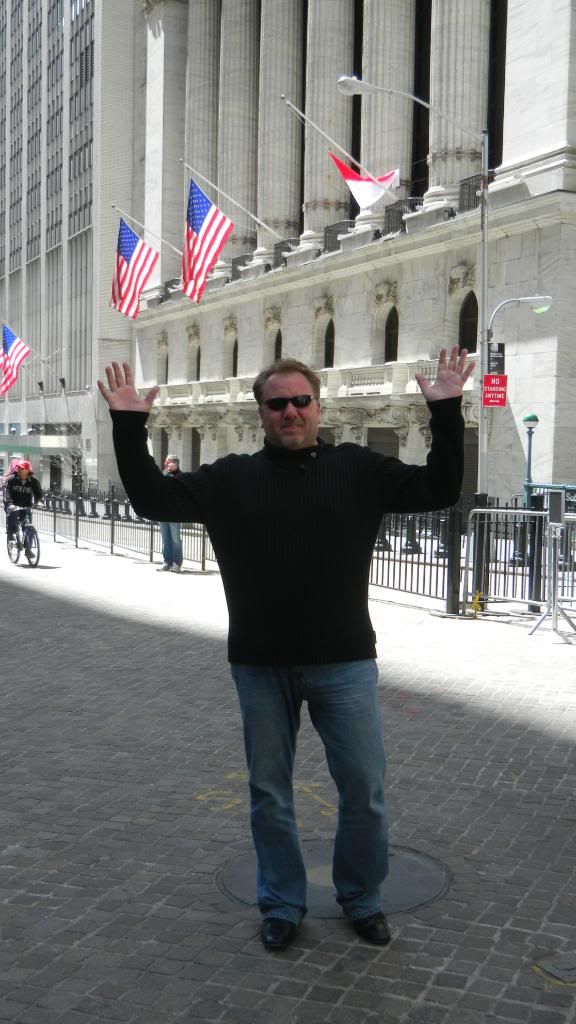
19. We asked for and you were kind enough to send us a photograph of things to come. The picture is of you standing on a manhole cover in the middle of Wall Street. Can you explain the importance of this picture?
All I can tell you is that I am very excited about Jack and going 'Up'!

20. Is there a historical figure that you admire and would one day consider writing about?
Our nation's Founding Father President George Washington has been on my mind for some time. There is a unique story and approach I want to write about of this great man. I am confident that one day I will. As I spoke about before, you have to make sure your research in completely accurate.